
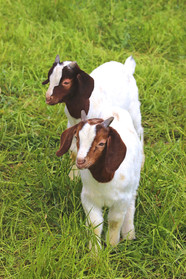
Two boer kid goats standing in a meadow. Photo courtesy Missouri Department of Agriculture
two kid goats on a meadow
A new guide developed by University of Missouri Extension and Lincoln University Extension offers insights into controlling gastrointestinal parasites in sheep and goats through forage-based management.
“Grazing systems, while offering several potential benefits, pose significant challenges for gastrointestinal parasite control in sheep and goats,” said David Brown, MU Extension small-ruminant specialist. “While effective dewormers can provide short-term relief, repeated and improper use has led to parasite resistance, resulting in the partial or complete failure of dewormers.”
Sheep and goats naturally harbor some internal parasites, and complete eradication is not feasible, Brown said. The goal should be to maintain manageable parasite levels. Parasitic loads can be minimized through proper grazing management and by providing high-quality forages. Proper nutrition is essential for increasing the host animal’s resilience to parasites, supporting health during infection, meeting production demands and enhancing resistance to parasitic infections, he said.
Topics in the guide include:
- Survival of larvae in the pasture.
- Condensed tannin-rich forages.
- Multi-species grazing.
- Rotational grazing.
- Dung beetles.
“Effective parasite control in sheep and goats requires an integrated approach alongside targeted deworming,” said Mohan Acharya, state extension small-ruminant specialist at Lincoln University and a co-author of the new guide.
“Grazing Management for Parasite Control in Small Ruminants” is free online at https://extension.missouri.edu/publications/g2613.
Two boer kid goats standing in a meadow. Photo courtesy Missouri Department of Agriculturetwo kid goats on a meadow
More Like This, Tap A Topic news
