
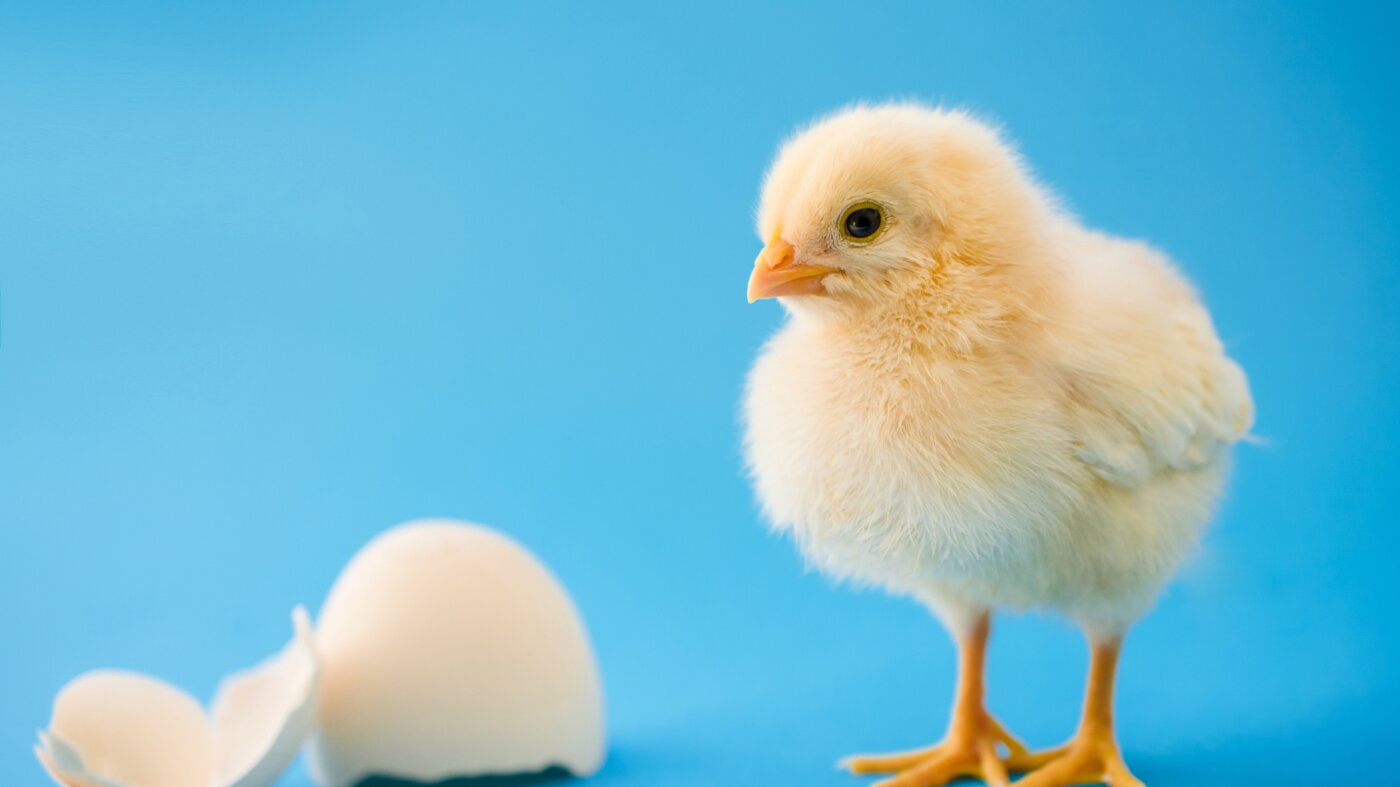
Child chickens seem to react equally to people when examined for one thing referred to as the “bouba-kiki impact,” which hyperlinks sure sounds to sure shapes.
Elena Goncharova/Getty Pictures
disguise caption
toggle caption
Elena Goncharova/Getty Pictures
When persons are proven a spiky form subsequent to a rounded one and requested which form is named “kiki” and which one is “bouba,” folks from all types of cultures overwhelmingly affiliate “bouba” with the blob-like form and “kiki” with the extra jagged, pointy one.
And it seems that child chickens do the very same factor.
A set of experiments with chicks, described within the journal Science, means that these birds, like people, affiliate the nonsense phrase “bouba” with roundness and “kiki” with spikiness.
“I used to be shocked by it,” says Marcus Perlman, a linguistics and communication researcher on the College of Birmingham in the UK, who wasn’t a part of the workforce that did the work. “If I needed to guess whether or not child chickens would exhibit the bouba-kiki impact, I’d have guessed no.”
The bouba-kiki impact has been studied for many years, with researchers displaying that even four-month-old human infants suppose that “bouba” applies to one thing rounded and “kiki” is one way or the other spiky.
That is led to hypothesis that such innate associations may have helped result in the emergence of speech, as a result of these associations would function a shared basis to construct on when creating new sorts of significant spoken symbols.
Efforts to discover a bouba-kiki impact in nice apes like chimpanzees and gorillas — animals intently associated to people — have come up empty. So a bunch of researchers on the College of Padova in Italy lately determined to take a totally completely different strategy to search for it in animals: they examined very younger chickens.
“With chicks, we had the possibility to check animals on the very, very first stage of life,” says researcher Maria Loconsole, who did the experiments with colleagues Silvia Benavides-Varela and Lucia Regolin.
Having the ability to check the chicks so younger would imply that any noticed associations between sounds and shapes could be innate, relatively than based mostly on expertise, she explains.
First, three-day-old chickens had been taught that in the event that they went behind a panel adorned with a mix form that was each blobby and spiky, they might get some meals. The chicks rapidly discovered to do that. Then, the scientists offered the chicks with two panels, one adorned with a blob-like form and one adorned with a spiky one.
That created a second of uncertainty for the chicks, says Loconsole. Throughout this second of uncertainty, the researchers performed both the sound “bouba” or the sound “kiki,” time and again. What they discovered is that the chicks considerably most well-liked to go to the panel with the rounded form once they heard “bouba.” Once they heard “kiki,” they typically most well-liked to go to the panel with the spiky form.
The same experiment with even youthful chicks, simply at some point previous, concerned displaying the chicks two video screens that displayed transferring objects. Chicks of that age will have a tendency to attract near a transferring, participating object. And what the researchers discovered is that once they performed the “kiki” sound, the chicks would transfer in direction of the spiky form. Once they heard “bouba,” they went to the rounded, blob-like form.
“I am not saying that chicks have human language,” says Loconsole. However to her, it is clear that, just like people, chicks have some fundamental linkages between completely different sorts of notion that “in our species was then co-opted and exploited for language.”
Which means that is one thing deeply rooted in evolution, says Perlman, going all the best way again to an ancestor of birds and mammals. “In order that’s fascinating,” he says. “It reveals that the vertebrate’s sensory methods are primed to count on sure regularities on this planet.”
There are different examples like this which have been seen in animals: high-pitched sounds are related to smaller, lighter objects, whereas lower-pitched sounds are related to bigger, darker figures.
And the bouba-kiki impact is simply a part of a broader suite of comparable sound-shape associations that individuals appear to share, says Perlman. One current research, for instance, discovered that individuals tended to match a trilled “r” sound with the sensation of a tough floor relatively than a clean one.
However people can hyperlink concepts not simply with sounds, however with gestures, too, and so they may even draw photos. That is why, in Perlman’s view, what actually differentiates people is a wide-ranging capability to generate novel symbols that talk that means—to principally play charades—in all types of how.
“We’re actually good at it, and successfully, no different animal does something like charades,” says Perlman. “That is a artistic capability, that possibly in some instances leverages sure hard-wired associations.”
