

Table of Contents
Quick answer: An affiliate marketing blog strategy that works starts with one niche, one clear audience, and content built around buying intent. The best affiliate blogs publish product comparisons, best tool lists, alternative posts, tutorials, and trust-building content in a structure that moves readers from research to decision. To rank well, your content also needs to be genuinely useful, original, and updated regularly, which matches Google’s people-first guidance.
If your affiliate blog gets traffic but barely makes sales, the problem is usually not effort. It is a strategy. A blog that earns affiliate revenue consistently does three things well. It targets the right search intent, it matches each article to the right offer, and it helps the reader make a decision instead of just giving them more information to consume.
This matters because affiliate marketing is still growing fast. Shopify reports that brands invested roughly $12 billion in creator partnerships in 2025, and Awin’s 2025 survey says brand partnerships now appear on 54% of affiliate programs, with sales from that partner type up 93% year over year on its platform. The opportunity is real, but so is the competition.
This guide will show you the affiliate marketing blog strategy that actually works in 2026, especially if you want rankings, clicks, and revenue from Google.
READ ALSO: What Are Digital Products? Examples That Make Money
Why most affiliate blogs struggle

A lot of affiliate blogs make the same mistake. They confuse traffic with revenue.
It feels good to see pageviews go up. But high traffic does not always mean high earnings. Your blog can attract thousands of readers who are curious, early in their journey, or just researching. If they are not close to making a buying decision, they are much less likely to click your links and buy.
That is why the blogs that make money usually do not start with random informational posts. They start with content that serves a buyer who is already comparing options, looking for the best tool, or trying to solve a specific problem.
Google’s own guidance makes this more important. Google says its systems aim to reward helpful, reliable, people-first content, not pages made mainly to manipulate rankings. It also says unique and valuable content matters for both classic search and AI search experiences.
SEE ALSO: 5 Highest Paying Remote Job Sites Nigerians Should Know
What an affiliate marketing blog strategy really means

An affiliate marketing blog strategy is the full plan behind how your blog attracts readers and turns that attention into commissions.
It includes:
- the niche you choose
- the keywords you target
- the audience you write for
- the products you recommend
- the type of articles you publish
- how those articles link to each other
- how often you refresh important pages
- how you capture emails and return visitors
Without that structure, most blogs become a pile of articles instead of a revenue system.
Start with one niche, not ten
This is where your strategy begins. Choose one niche where people already spend money and where affiliate programs are easy to find.
Good affiliate blog niches usually include:
- software
- web hosting
- online business tools
- creator tools
- finance tools
- email marketing
- productivity
- education
- fitness
- home and lifestyle products
A good niche has three things. Search demand, products with affiliate programs, and an audience with problems they are willing to pay to solve.
If you are not sure whether a niche is strong enough, ask yourself one simple question.
Can I list at least 20 products or services people compare before buying?
If the answer is yes, that niche has affiliate potential.
Focus on buying intent first
This is where many affiliate blogs go wrong.
They publish broad informational posts first because the keywords look easier. But those posts often attract readers who are not ready to buy yet. A stronger affiliate marketing blog strategy starts with high-intent content.
These are the article types that usually drive the most affiliate revenue:
Best tools posts
Examples:
- best email marketing tools for creators
- best project management software for freelancers
- best AI writing tools for bloggers
These work because the reader is already choosing between options.
Comparison posts
Examples:
- ConvertKit vs MailerLite
- Jasper vs Copy.ai
- Ahrefs vs Semrush
Comparison posts often convert well because the reader is very close to a decision.
Alternatives posts
Examples:
- Mailchimp alternatives
- Notion alternatives for teams
- Canva alternatives for designers
These are strong because the person searching is actively looking for a replacement.
Pricing posts
Examples:
- ConvertKit pricing explained
- Kajabi pricing for beginners
- Canva Pro cost and whether it is worth it
Readers searching for pricing are often near the bottom of the funnel.
Product-led tutorials
Examples:
- how to build a newsletter with Beehiiv
- how to create a course in Teachable
- how to use Notion for content planning
These can rank well and convert because they show the product in real use.
OUR SUBSCRIBERS ENJOYED READING: Best Graphic Design Tools for Beginners in Nigeria (Free and Paid Options)
The content mix that usually works best
You do still need informational content.
But it should support your money pages, not replace them.
A strong affiliate blog usually has three content layers:
1. Revenue content
These are your money pages.
They include best tool lists, comparisons, alternatives, reviews, and pricing posts.
2. Supporting content
These help readers understand the problem.
Examples:
- what is email marketing
- what is CRM software
- how affiliate marketing blog strategy works
- what makes a good landing page
These pages may not convert directly, but they build traffic and internal linking power.
3. Trust content
This is the content that makes readers believe your recommendations.
Examples:
- what I liked after using X for 30 days
- mistakes to avoid when choosing a webinar tool
- who should and should not use X
This type of content is underrated. It helps readers feel that your recommendation is real, not forced.
The best affiliate blog structure for rankings and revenue
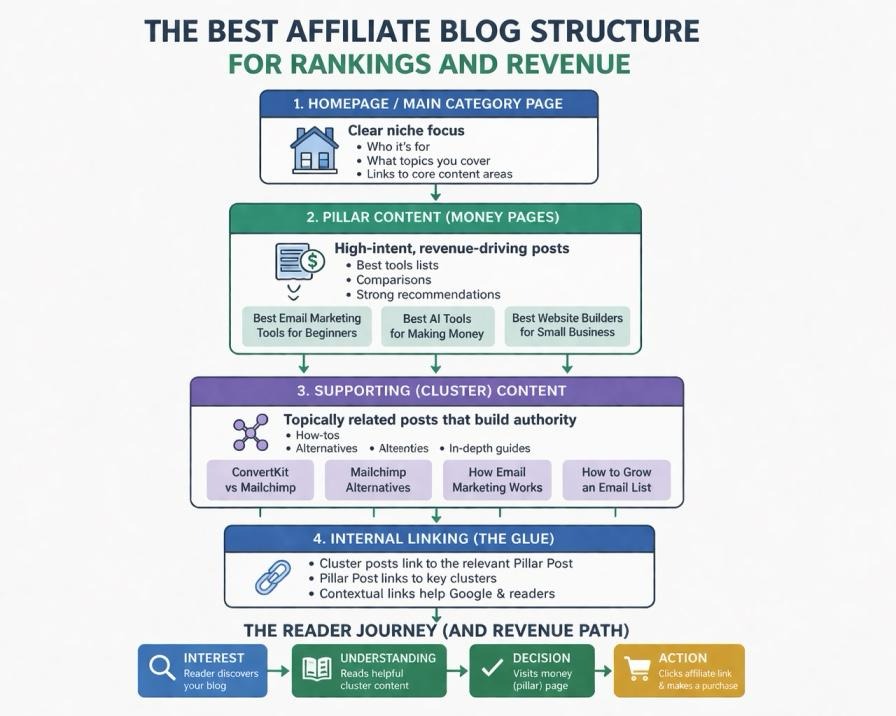
A blog that ranks and earns should feel easy to follow.
One simple structure looks like this:
Homepage or category page
Targets the broad niche and links to your main content areas.
Pillar posts
These are major articles around your core topic.
Example:
Best Email Marketing Tools for Small Businesses
Cluster posts
These support the pillar with related articles.
Examples:
ConvertKit vs MailerLite
Best Free Email Marketing Tools
Mailchimp Alternatives
How to Choose an Email Platform
Internal links
Your informational posts should guide readers toward comparison and decision pages.
This is important because it helps readers move from interest to action.
It also helps Google understand your site structure better. Google’s Search Essentials specifically recommends using clear words in titles and headings and making links crawlable so Google can find and understand your pages.
How to choose the right affiliate products
Do not choose products only because they pay high commissions.
Sometimes a lower commission converts much better because the product is more trusted, easier to use, or a better fit for your audience.
Choose affiliate products based on:
- relevance to the article
- usefulness to the audience
- brand trust
- ease of use
- price point
- commission structure
- cookie duration
- refund risk
The product should fit the article naturally.
If you are writing about the best blogging tools for beginners, a complicated enterprise product probably does not belong there, even if the payout is high.
What makes affiliate content convert better
A lot of affiliate blog posts sound the same.
That is a problem.
If your article feels like a recycled list with generic pros and cons, readers will not trust it. Google is also less likely to see it as uniquely valuable. Google says content created with little originality or little added value can be a problem, especially when scaled. It also says using AI is fine, but not when it is used to generate many pages without value for users.
What helps affiliate content convert better is simple:
- Be specific
Do not just say a tool is great. Explain who it is great for.
- Show trade-offs
Readers trust you more when you explain what a product does badly, not just what it does well.
- Use clear use cases
Instead of ranking everything in one list, break it down:
- best for beginners
- best for teams
- best for advanced users
- best low-cost option
4. Keep it current
Outdated prices, missing features, and dead screenshots quietly kill conversions.
5. Give a final recommendation
Do not make readers work too hard to know what you think.
The easiest affiliate content formula to follow
If you want a structure that works for most money posts, use this:
Start with the recommendation
Tell the reader the answer early.
Example:
The best email marketing tool for beginners is MailerLite if you want low cost and simplicity. ConvertKit is a better fit if automation matters more.
Explain how you judged the options
This could include:
- ease of use
- pricing
- features
- support
- templates
- integrations
- beginner friendliness
Break each product down clearly
Keep a consistent format for each tool or product.
Add practical insight
Mention setup time, hidden costs, limitations, or who the tool is not for.
End with a final pick
Help the reader move forward.
Why email still matters in affiliate marketing blog strategy
Search traffic is valuable.
But email helps you make that traffic more useful.
A reader may land on your article today, not buy, and leave.
If you collect their email with a useful free resource, you get another chance to help them later.
Simple lead magnets work well:
- checklists
- comparison sheets
- templates
- short email courses
- product selection guides
This is one reason the best affiliate blogs feel more stable. They are not depending on one click from one search visit.
Update your money pages often
This is one of the biggest differences between blogs that fade and blogs that grow.
Affiliate content goes stale quickly because tools change, prices move, features get added, and some products become worse while new ones become better.
A practical update routine looks like this:
- review top affiliate pages every 60 to 90 days
- update prices and screenshots
- remove dead tools
- add stronger alternatives
- improve intros and call to action sections
- check all affiliate links
This also helps with AI search. Google says unique and valuable content matters in AI experiences, and page experience still matters too. If your content is current, useful, and easy to use across devices, it is in a stronger position.
Track revenue, not just rankings
This is where strategy becomes real.
Do not only track pageviews and keyword positions.
Also track:
- affiliate clicks
- conversion rate
- revenue per post
- earnings per click
- email signups by article
- top performing content types
Sometimes the page with less traffic makes far more money. That is the page you should optimize first.
Shopify’s recent affiliate metrics guide also highlights the importance of looking beyond clicks and tracking actual business outcomes, including fraud, fake leads, and real revenue performance.
A simple affiliate blog content plan that works
If you are building from scratch, this is a strong starting point.
Month 1
Publish:
- 3 best tools posts
- 3 comparison posts
- 2 alternative posts
- 2 supporting informational posts
Month 2
Publish:
- 3 tutorials built around affiliate products
- 2 pricing posts
- 2 problem-solving posts
- 2 trust posts
- 1 lead magnet page
Month 3
Refresh:
- your top commercial posts
- internal links
- intros and call to action sections
- outdated product details
- FAQ sections
This gives you a balanced system instead of random blog publishing.
Common affiliate blog mistakes
- Chasing broad keywords too early
This usually brings traffic that does not convert.
- Promoting too many products
It makes the blog feel scattered and weakens trust.
- Writing thin reviews
Readers can feel when the article adds no real value.
- Ignoring internal linking
That makes it harder for readers to move through your funnel.
- Publishing and forgetting
Affiliate posts need regular updates to stay useful.
- Writing for algorithms first
Google’s guidance is clear. People-first content should come first.
What an affiliate marketing blog strategy that works looks like in practice
A working strategy is usually simple.
You choose one niche.
You choose one audience.
You publish high-intent articles first.
You recommend products that fit those articles naturally.
You build supporting content that feeds your money pages.
You collect emails.
You refresh what you already earn.
That is not flashy, but it works.
Conclusion
An effective affiliate marketing blog strategy is not built on publishing more content for its own sake. It is built on intent, structure, relevance, and trust.
If your content helps the right reader make the right decision at the right time, your blog is far more likely to earn both rankings and commissions.
For more practical articles on affiliate marketing blog srategies, online income, and digital business, subscribe to WikDaily
Frequently Asked Questions (FAQ)
What is the best affiliate marketing blog strategy?
The best affiliate marketing blog strategy is to focus on one niche, publish buying-intent content first, match each article to the right offer, build trust with useful and honest recommendations, and update your highest-earning pages regularly.
What type of affiliate blog posts make the most money?
Best tools posts, comparison posts, alternatives posts, pricing articles, and product-led tutorials usually make the most money because they target readers who are closer to buying.
How many blog posts do you need before affiliate marketing works?
There is no exact number, but many blogs start seeing early traction once they publish 15 to 30 focused, commercially relevant articles with good internal linking and useful recommendations.
Can affiliate blogs still rank on Google?
Yes. Google says its systems aim to prioritize helpful, reliable, people-first content. Affiliate blogs can still rank well when they provide original value, strong page experience, and genuinely useful recommendations.
Is affiliate marketing still worth it?
Yes. Recent data from Shopify and Awin show continued brand investment and growth in affiliate and creator partnerships, indicating the channel remains very active for publishers who build trust and solve real buyer problems.
