
Table of Contents
Tomato farming has grow to be a high-stakes, high-input enterprise the place success will depend on getting many transferring elements proper without delay. From seed alternative and soil preparation to local weather management, irrigation, diet and pest administration, each stage of the crop’s life cycle calls for exact, season-specific choices.
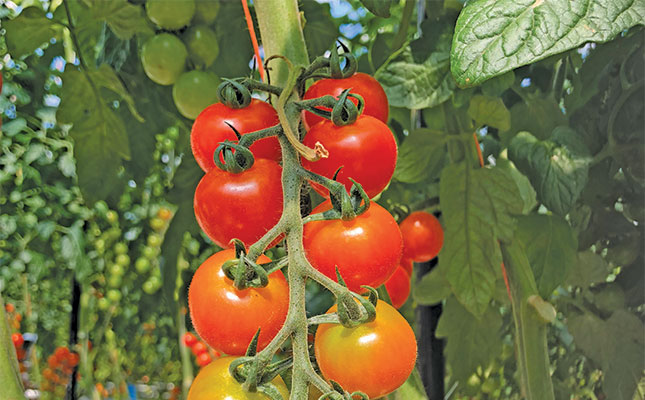
Producing tomatoes beneath protected environments is an efficient resolution to guard the crop in opposition to biotic and abiotic stress elements. These buildings defend the tomatoes in opposition to excessive temperatures, photo voltaic radiation, wind, and hail and also can assist to enhance water use effectivity. Picture: Magda du Toit
– ADVERTISEMENT –
Profitable tomato manufacturing is set by a mess of interactive components akin to selection alternative, environmental circumstances, the climate, soil well being, and administration practices. Understanding how every of those work together with the others is the important thing to unlock the potential good yields, delivering a high-quality product, and optimising revenue.
“A holistic strategy is required,” emphasises Werner Wessels, space gross sales supervisor at SADC South International locations, Syngenta Vegetable Seeds.
“Balancing environmental circumstances, plant physiology, water administration, and soil well being is necessary. When farmers perceive this, they’ll make knowledgeable choices and optimise their manufacturing for long-term success,” he says.
Based on Jandri Venter, chargeable for product growth at Rijk Zwaan, growers require an important deal extra capital to provide tomatoes than 10 years in the past.
“Farmers who ponder planting tomatoes needs to be ready to pay extra for inputs. As well as, retailers and customers are demanding a better high quality product, subsequently a extra intensive crop safety programme is required,” he says.
The overwhelming majority of tomatoes in South Africa are nonetheless produced beneath open area circumstances.
Wessels highlights that rising tomatoes efficiently begins with understanding the crop and its development levels.
“Tomato crops undergo distinct vegetative and generative levels influenced by seasonal modifications that lead to a continuing shift between heat, dry, overcast, or wet circumstances, in addition to the distinction in day and night time temperatures and day size and light-weight depth.”
As well as, Venter advises that earlier than planting, farmers ought to safe a marketplace for their produce.
“Previously it was straightforward to ship merchandise to the recent markets within the larger centres, however with the present scenario at among the markets, this isn’t [necessarily] a smart technique to construct your corporation on.
“Tomato producers ought to make sure that they’ve a three-market offset technique that provides them entry to grocery store teams or particular person shops, the casual market, in addition to the recent produce markets. It is going to additionally assist farmers unfold danger.”
Manufacturing levels
Whatever the selection, all tomatoes comply with a organic cycle ranging from seed germination to harvesting, with every particular person stage of the cycle demanding particular administration practices in accordance with the environmental circumstances, Wessels explains.
“The six levels are germination, the seedling section, vegetative development, flowering, fruit growth, and harvesting. By understanding these levels, farmers will be capable of present the optimum circumstances for development and growth, and high quality merchandise,” says Wessels.
- Germination
As with many different crops, all of it begins with the seed. The inherent potential of the crop lies within the seed.
“How farmers handle the crop will decide yield and high quality,” says Wessels.
The best steadiness of moisture along with soil and air temperature will assist the seed to germinate. Particular crop care is critical throughout the germination interval.
- Seedling section
Relying on the temperature, it takes about 5 to 10 days for tomatoes to germinate. As soon as the cotyledons seem, the seedling stage begins. The cotyledons are essential for beginning photosynthesis as the method gives the power for the seedling to develop.
Step by step the plant will start to develop true leaves and outgrow the containers.
That is the time to transplant the seedlings.
Root growth is usually an ignored issue. Based on Wessels, a wholesome root system is crucial for plant vigour and productiveness.
“Guaranteeing correct irrigation, nutrient steadiness, and aeration is vital for sturdy root growth. A powerful root system will allow the seedling to ascertain correctly.”
- Vegetative stage
In the course of the vegetative stage, the tomato plant’s stems will thicken and foliage will improve. This development spurt requires plenty of power, subsequently the demand for water and vitamins rises considerably. Additionally it is mandatory to begin listening to offering sturdy structural assist to the plant.
“Trellising and pruning grow to be important. Pruning is critical to maintain the plant in steadiness. For indeterminate tomato varieties, which develop constantly, it’s advisable to take away among the suckers to keep up plant form and dimension,” says Venter.
- Flowering
Throughout the next reproductive levels of the plant, nutrient administration is essential, Venter factors out.
“Use fertiliser to encourage blooming and to assist flower and fruit growth. Throughout a plant’s life cycle it has totally different dietary wants, and the fertiliser programme should correlate to these wants.”
- Pollination
There are numerous elements that may have an effect on pollination. Based on Wessels, if circumstances are too sizzling or chilly, or if humidity ranges are too excessive, pollination could be affected. - Fruit growth
After pollination, the flowers will start to wither, after which small inexperienced fruits will emerge. At this cut-off date the crops wants sufficient water to stop stress.
“Stress throughout this stage can lead to fruit loss. It is very important repeatedly examine the soil moisture and modify fertigation to assist the rising fruit,” states Wessels.
- Harvesting
Indeterminate varieties that proceed to provide fruit all through the season want fixed administration and upkeep to make sure a steady harvest.
“Selecting ripe tomatoes indicators the plant to provide extra fruit, so common harvesting is a part of the continuing care.”
Making knowledgeable manufacturing choices
Based on Wessels, there isn’t a single trigger for lowered yield or high quality in tomatoes.
“Preserving detailed information of previous crops could also be useful to establish and handle points early.”
He lists the next necessary features that forestall yield loss and enhance fruit high quality:
- It’s advisable to pick disease-tolerant and tailored varieties for particular areas and circumstances;
- Comply with a balanced diet programme with sufficient potassium and correct pH ranges;
- Forestall stress throughout the rising season;
- Keep away from unfavourable seasons, particularly in open area manufacturing;
- Forestall extreme vegetative development;
- Regularly harvest indeterminate varieties to keep up fruit high quality;
- Minimise publicity of the fruit to direct daylight.
Manufacturing strategies
Relying on the area, the market, and the range, tomatoes could be grown beneath varied sorts of protected environments or in open fields. All strategies have distinctive benefits and challenges. Venter emphasises that it is very important perceive the challenges and benefits as a way to optimise yields, high quality, and profitability.
“The selection between protected or open- area tomato manufacturing will depend on a number of elements together with funds, local weather, market demand, and manufacturing objectives,” says Venter.
Though manufacturing prices in protecting environments is greater, equally necessary is the higher packout share as a consequence of better- high quality fruit produced.
“To provide tomatoes beneath safety affords greater and extra constant yields and good fruit high quality, and allows farmers to provide for an extended interval throughout the 12 months, however requires greater funding and administration abilities.
“If price is an element, open-field farming could be extra accessible, however farmers should think about the dangers related to unpredictable climate circumstances,” Venter advises.
Protected manufacturing
Rising tomatoes in a protected setting entails manufacturing beneath cowl in plastic buildings or beneath nets and affords exact management over temperature, humidity, irrigation, and pest administration, Venter explains.
Due to the management the grower has over many features, manufacturing no matter exterior climate circumstances can also be potential because the buildings defend crops from excessive climate circumstances akin to heavy rain, hail, or sturdy winds that may injury crops in open fields.
On account of the extreme farming practices, farmers usually get hold of greater yields and higher high quality fruit, with fewer blemishes and illnesses.
“Steady manufacturing permits farmers to produce markets throughout off-seasons, usually fetching premium costs,” says Venter.
Growers can select from varied greenhouse buildings akin to plastic tunnels, self- ventilated multi-span greenhouses, local weather managed greenhouses or internet homes.
“All of those are appropriate for rising tomatoes, and the selection will rely largely on the native environmental circumstances, in addition to the quantity the grower is prepared or in a position to make investments. Typically phrases, we refer to those buildings and circumstances as low, medium or excessive tech.”
Venter explains that beneath high-tech circumstances, growers make use of automated local weather management, airflow, irrigation, fertigation and moisture management. Managed setting buildings akin to plastic greenhouses require greater upfront funding as a consequence of development, heating, air flow, and labour. It is going to additionally require a better stage of intensive administration, Venter provides.
“As a grower, you wish to drive excessive and high quality yields from each sq. metre to get a return on funding.”
Based on Wessels, as a rule of thumb, the expansion cycles in internet or greenhouses are as follows:
- Quick cycle: 140 to 150 days from planting to reap;
- Lengthy cycle: 10 to 11 rising months, together with 9 months of harvesting.
In any of the buildings that can be utilized when producing in a protected setting, mild depth stays one of many essential components.
“Mild instantly impacts sugar manufacturing, fruit growth, transpiration, and total plant well being. Correct nutrient steadiness at every development stage is crucial to keep up excessive yields and premium fruit high quality all through the season,” Wessels emphasises.
Open area
In South Africa, the overwhelming majority of tomato manufacturing remains to be carried out in open area circumstances the place the manufacturing depends on pure circumstances. The preliminary capital wanted, subsequently, is lower than for manufacturing in a protected setting, and growers can also profit from decrease operational prices since there isn’t a want for complicated infrastructure or power inputs for local weather management.
Open-field tomatoes are often grown seasonally and are topic to climate variability and rainfall. Yield per hectare beneath open- area manufacturing could also be decrease and extra variable as a consequence of dependency on climate and elevated vulnerability to pests and illnesses.
Crop rotation is necessary when doing open-field manufacturing.
“The perfect system is to solely replant the identical area after three years,” says Venter.
Common administration practices
Soil preparation
Correct soil preparation improves the potential for worthwhile manufacturing of tomatoes. Major soil preparation should be aimed toward creating rising circumstances for tomato crops to develop the optimum root system for a selected soil profile.
“Though the basis construction of a tomato plant can penetrate varied soil sorts as much as depths of 2m, the best share roots will probably be discovered within the prime 600mm of the soil.”
Wessels factors out that some great benefits of soil preparation are:
- No restrictions on root growth;
- Much less likelihood of compaction;
- Extra oxygen within the soil, creating higher root growth;
- Increased yield;
- Discount in manufacturing prices;
- Extra vegetative development;
- Higher tolerance to drought and stress;
- Much less root illness prevalence;
- Horizontal and vertical compaction layers damaged;
- Higher water retention;
- Elevated uptake of moisture and vitamins.
The selection of the soil preparation methods needs to be decided by the necessities of the plant and soil.
Wessels says that no normal soil well being system could be really useful on all soil sorts. The selection of preparation technique needs to be made primarily based on the clay content material of the soil.
As well as, soil preparation needs to be achieved to depths various between 200mm and 400mm. Ridging is very really useful and needs to be achieved in line with the land contours. The principle benefit of ridging a tomato crop is to maintain extra water away from the plant, improved oxygenation of the basis zone, elevated soil depth within the rising mattress, and higher root growth.
- Planting durations
Wessels notes that there are numerous elements influencing the choice and timing to plant.
“Temperature has a significant impact on plant development, flowering and fruit set. Tomatoes develop and produce the very best when the imply temperatures are between 20°C and 24°C. That is, nonetheless, a really basic assertion, because the impact of excessive temperature within the day could be offset by a decrease night time temperature, or in some circumstances by decrease mild depth.”
Vegetation have the power to develop effectively at temperatures effectively above 30°C, however these temperatures have a unfavourable impact on fruit set.
Tomatoes require very steady temperature ranges, with minimums and maximums not being too vast aside.
“The crucial issue with regard to fruit set is the night time temperature, which needs to be from 15°C to twenty˚C for the optimum set. When the typical every day temperature is above 32°C and the night time temperature is above 21°C, fruit set is poor. Fruit set usually fails under 13°C.”
Based on Wessels, the institution durations for the primary manufacturing areas of South Africa will probably be:
1. Lowveld (frost-free areas) – February to Might
2. Middleveld (average areas) – September to December
3. Highveld (chilly areas) – October to November
4. Western Cape – October to December.
- Trellises
The area in a greenhouse is prime actual property. Vertical manufacturing multiplies the manufacturing area and capability with out the necessity to increase the greenhouse space.
As well as, fruit-bearing crops like tomatoes, cucumbers, peppers, and aubergines can triple their yield when supplied with correct assist buildings.
Indeterminate tomatoes want a sturdy assist system to stop department breakage. High quality trellises distribute plant weight evenly throughout a number of contact factors. Trellised crops obtain extra constant and even mild publicity on all sides of the plant.
The improved mild distribution will increase photosynthesis and results in extra uniform fruit ripening, and with correct coaching, higher airflow could be obtained within the greenhouse, lowering fungal illnesses that thrive in humid circumstances.
- Layering
Layering is a horticultural approach used to increase the tomato rising cycle. It entails fastidiously reducing the primary stem from the highest of the trellis and layering it horizontally, permitting new development to proceed upward.
This technique allows a single tomato plant to succeed in lengths of as much as 13m whereas sustaining fruit manufacturing at a handy top for harvesting. Earlier than reducing the plant, all outdated leaves needs to be pruned to make sure sufficient airflow and scale back illness danger. For greatest outcomes, create a assist construction above your ridges or develop baggage to maintain stems off the bottom and forestall injury.
- Pests and illnesses
All through all the expansion levels, tomatoes could be contaminated with varied pests and illnesses. Correct spacing and crop rotation may help with managing pests.
The commonest and in addition crucial illnesses in tomatoes embrace: - Tomato noticed wilt virus (TSWV) is a viral illness that’s transmitted by a vector akin to thrips.
“It causes critical losses of economically significance in tomatoes,” Venter notes. - Fusarium wilt is a soil-borne fungal illness attributable to Fusarium oxysporum f. sp. lycopersici, which causes yellowing and wilting. Fusarium will have an effect on the decrease leaves of the plant first.
- Tomato yellow leaf curl virus (TYLCV) is a virus from the genus Begomovirus and the household Geminiviridae. “TYLCV is likely one of the most critical illnesses affecting tomato crops, particularly in subtropical areas, the place it may trigger main crop losses,” Venter warns.
- Tomato curly stunt virus is an economically necessary Begomovirus. “Contaminated crops painting signs akin to yellowing, leaf curling, stunting and fruit set discount,” Venter explains.
Based on Venter, it’s essential to think about illness resistance when choosing each varieties and rootstocks. For open-field manufacturing, the place grafting is much less sensible, the scion selection ought to ideally have resistance to TSWV, TYLCV, Fusarium races 1 to three, and nematodes.
In protected cultivation, the place grafting affords a better return on funding, the rootstock ought to present resistance to Fusarium races 1 to three, nematodes, and, as an added benefit, bacterial wilt. This strategy ensures higher plant well being and long-term productiveness.
- Environmental stress
Environmental elements akin to excessive temperatures, insufficient water, or poor soil circumstances can stress tomato crops.
Manufacturing beneath managed circumstances may help to mitigate a few of these features. By offering shade throughout sizzling spells, mulching to retain soil moisture, and guaranteeing the soil is well-draining and wealthy in natural matter, stress could be lowered. - Water administration
The supply of water within the soil is one other necessary requirement for profitable tomato manufacturing.
“Enough moisture is critical for good crop institution, development, fruit growth in addition to high quality. To this finish, producers should give high-level consideration to water availability, irrigation scheduling, and water high quality,” says Jovan Erasmus, agronomist at Netafim Southern and East Africa.
“Effectivity in water software is of utmost significance. Water needs to be utilized no faster than it may penetrate the actual soil or development medium. If water collects on the floor, it causes soil crusting, and the place it begins operating off, erosion. You should additionally know the way the water is distributed within the soil, figuring out how deep and the way vast the water reaches,” Erasmus factors out.
Based on him, rising in a protected setting, particularly in soilless media, requires final precision in water and nutrient software.
“The usage of superior compensated non-leakage drippers, mixed with multi- channel nutrient dosing tools, helps to create the right root-zone setting.”
Precision irrigation just isn’t solely the very best resolution for the applying of water, but in addition probably the most environment friendly technique for making use of fertilisers.
“Fertigation allows you to ship vitamins in measured doses, and with good timing, to assist optimum plant development and defend your soil from leaching and groundwater contamination.
The standard of the water has an enormous impact on the longevity of the irrigation system.
Poor-quality water will increase the chance of clogging the system and drippers, subsequently farmers ought to repeatedly examine the water high quality. Drippers should stay open to operate on the deliberate charges,” Erasmus states.
As well as, he emphasises that water high quality additionally has an enormous impact on the solubility of fertilisers.
“If the fertiliser doesn’t dissolve, it may clog up the dripper system, and the crops is not going to obtain the vitamins that they should develop and produce. Yield could be affected as one can lose your complete plant if a dripper just isn’t functioning correctly. That is much more crucial in a high-tech setting akin to hydroponics methods,” he says.
The pH of the water is one other facet that ought to obtain sufficient consideration. “The pH also can have an effect on the working of fertiliser in addition to pesticides, nematicides or fungicides.”
Guaranteeing the proper electrical conductivity, pH, and nutrient ranges within the root zone is crucial for fast-growing and high-yielding crops. That is very true when rising in soilless media, because the rising medium has low buffer capabilities and calls for a quick and exact response.
“You want a system that may react rapidly to any change, be it crop stage or local weather. This may be the distinction between profitable and shedding. Precision drip methods are primarily based on compensated non-leakage drippers, designed for pulse irrigation and particular dosing methods that will let you hold all parameters precisely the place you want them, and react to modifications on demand,” says Erasmus.
The area in a greenhouse is prime actual property. Vertical manufacturing multiplies the manufacturing area and capability with out the necessity to increase the greenhouse space.
Irrigation of soilless media is characterised by brief irrigation pulses (minutes), and it’s advisable that producers over-irrigate by roughly 20% to make sure that salts don’t construct up within the pots. The extra water will assist to leach among the salts, Erasmus explains.
Below nets in soil this isn’t necessary because the methods are usually scheduled to irrigate for longer durations.
“Via applied sciences akin to drip irrigation and real-time monitoring methods, Netafim allows farmers to be extra environment friendly and exact, driving to scale back waste. Drip irrigation is very environment friendly as a system. Low-flow drip irrigation methods additional permit farmers to irrigate bigger areas concurrently.”
- Local weather administration
Based on Wessels, tomatoes are a heat season crop. “It might survive sure quantities of chilly models, however are illiberal of very low temperatures. Most significantly, tomatoes require very steady temperature ranges with minimums and maximums not being too vast aside.
“Giant temperature variations would possibly lead to poor fruit high quality or lowered yields,” he states.
“The variation in weather conditions in South Africa permits the planting and manufacturing of good-quality recent tomatoes in open fields in varied elements of the nation all 12 months.”
Based on Wessels, the minimal temperature for manufacturing needs to be round 10°C, with the utmost being 34°C. Optimum temperatures are round 26°C to 29°C. (The desk to the proper reveals the required temperature ranges per growth stage for optimum tomato manufacturing.)
- Soil well being
For worthwhile manufacturing, soil well being and fertility are key, Wessels advises.
“The standard and amount of tomato fruits are tremendously influenced by the fertility and nutrient ranges of the soil.”
He factors out that though tomatoes will develop reasonably effectively in a variety of soil sorts, by way of the soil construction and content material there are elements that may have a significant impression on yield and decide the financial viability of the farming enterprise.
These elements embrace:
- Nutrient composition;
- Compaction;
- Efficient soil depth;
- Soil pH;
- Crop rotation;
- Herbicide residues;
- Water-holding capability.
“The soil should allow sufficient root development to assist the plant and provide water, oxygen and mineral vitamins, and should be freed from poisonous components,” he provides.
Wessels explains that the speed of root development relies on the diploma of compaction or bulk density of the soil.
“The diploma of soil compaction varies with soil kind and placement. The speed of aerial and root development of tomato crops will increase with the oxygen contents of the soil. Root density is highest the place there’s a excessive charge of diffusion. Root growth of tomato crops could be intensive if soil water and plant circumstances are optimum. They are often as deep as 1,5m and as vast as plant spacing will permit.”
Based on Wessels, early root growth needs to be inspired, as a result of almost all root development happens earlier than fruit set.
As well as, the significance of natural matter within the soil can’t be overemphasised, he notes.
“Natural matter within the type of decayed leaves, compost, sawdust or animal manure is a supply of plant vitamins and acts as a soil conditioner. It will increase the capability of the soil to retain water and vitamins. It additionally promotes root development and the infiltration of water and air into the soil.”
- Diet
Tomato crops should preserve a steadiness between leaf growth and fruit manufacturing. Wessels factors out that an imbalance on this relationship can negatively impression yield, fruit high quality, and the crop’s longevity.
“Overly vegetative crops yield lower than well-balanced crops. Overly skinny crops with small leaves might lack adequate leaf space to provide the sugars mandatory for fruit enlargement.
“A plant producing 13 trusses with 5 fruits per truss can achieve 1,3kg per plant just by including 20g per fruit on common,” Wessels explains.
The perfect temperature vary for sugar assimilation in tomato crops is 23°C to 25°C. Deviations from this vary will impact the tomato, says Wessels.
Decrease temperatures will lead to sluggish ripening and poor color growth, whereas greater temperatures will lead to quicker ripening, an elevated danger of blotchy ripening, and a shorter shelf life.
- Dietary imbalances
Nutrient deficiencies or excesses can result in issues like yellowing leaves or blossom
finish rot. A balanced fertiliser needs to be used in line with the outcomes of normal soil and depart evaluation, says Venter.
“Adjusting the fertigation schedule because the plant progresses by means of its development levels can even assist to stop imbalances.”
E mail the Tomato Producers’ Organisation at [email protected], Werner Wessels at [email protected], or Jandri Venter at [email protected]. Go to rijkzwaan.co.za.
🌾 Loved this text?
Get trusted farming information from Farmers Weekly in Google Prime Tales.
➕ Add Farmers Weekly to Google
✔ Takes 10 seconds · ✔ Take away anytime
