
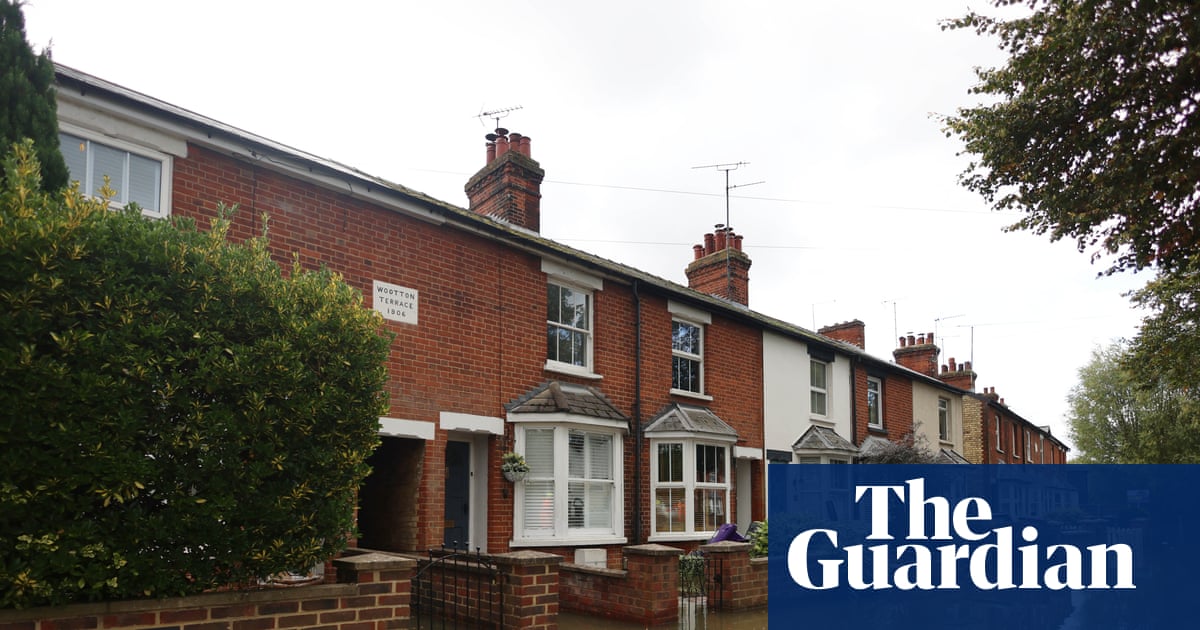
One in 9 new properties in England constructed between 2022 and 2024 have been constructed in areas that would now be prone to flooding, in response to new information.
The figures present the variety of properties being inbuilt dangerous areas is on the rise – a earlier evaluation confirmed that between 2013 and 2022, one in 13 new properties have been in potential flooding zones.
The analysis comes with the federal government underneath enormous strain to ship new reasonably priced housing, amid indicators that the local weather breakdown is accelerating.
Knowledge revealed by the insurer Aviva reveals that of the 396,602 new properties recorded by the Ordnance Survey in England between 2022 and 2024, 43,937 are in areas of medium or excessive danger of flooding, whereas 26% of latest properties have some danger of flooding.
Emma Howard Boyd, former chair of the Atmosphere Company, who advises Aviva on local weather coverage, mentioned the federal government’s goal to construct 1.5m properties this parliament may create strain to construct in areas at excessive danger of flooding.
She mentioned: “We don’t need to be constructing as we speak’s homes in locations the place they are going to grow to be ever extra prone to flooding. Defra [the Department for Environment Food and Rural Affairs] and the Ministry for Housing should be working shut collectively to ensure our housing targets aren’t stopping what we all know is required to guard future and present properties from future ranges of flooding.”
Aviva’s information additionally reveals that by 2050, one in seven (15%) of the properties constructed between 2022 and 2024 shall be at medium or excessive danger of flooding and nearly a 3rd (30%) will face some sort of flood danger, as extra excessive rainfall is predicted because of local weather breakdown.
The federal government mentioned the evaluation doesn’t consider flood defences that are already in place, although this was disputed by Aviva, which mentioned it does.
Specialists have mentioned London’s flood defences, for instance, should be urgently up to date to guard the town.
The analysis comes after a Guardian investigation final 12 months discovered that thousands and thousands extra properties in England, Scotland and Wales are going through devastating floods, and a few cities might must be deserted as local weather breakdown makes many areas uninsurable.
That evaluation revealed the extent of concern within the insurance coverage sector as bigger areas of housing and business property grow to be at a better danger.
Aviva’s evaluation, which pulls on the brand new properties tackle information and cross-references it with the Atmosphere Company’s newest evaluation of flood danger at constituency stage, discovered that Higher London and Essex have the very best proportion (32%) of latest at-risk properties. Lincolnshire, East Yorkshire, the west and north-west observe at 13%. The east of England has the bottom proportion of latest at-risk properties at 2%.
Some areas of the UK are prone to being deserted due to flood danger, with the occupants of a terrace in Ynysybwl, Wales, having their properties purchased by the council as a consequence of fixed flooding. The city of Tenbury Wells can also be being slowly deserted by its occupants as they can’t get flood insurance coverage.
Individuals who dwell in new builds can discover it harder to get flood insurance coverage. Houses constructed since 2009 are excluded from the government-backed Flood Re reinsurance scheme, which insures affordability and accessibility to flood insurance coverage for owners.
Jason Storah, the chief government of UK and Eire basic insurance coverage at Aviva, mentioned: “As our evaluation reveals, too many new properties have been inbuilt larger danger areas. It’s significantly worrying that this development has risen lately, simply as housebuilding accelerates.
“Importantly, these properties are usually not protected by the Flood Re scheme, which excludes properties constructed after 2009 to stop extra new properties being put in danger. Sadly, because the examine reveals, this merely hasn’t occurred.”
Aviva is looking for the federal government to strengthen planning laws to stop new unprotected properties being inbuilt flood zones.
Storah added: “We imagine there needs to be a presumption towards new developments in high-risk areas within the planning guidelines, alongside obligatory flood resilience measures in constructing laws for brand spanking new properties in areas in danger. That is significantly essential in locations the place floor water flooding is prevalent, which is harder to foretell and defend towards.
“In some areas, it won’t be a case of if however when a house will flood.”
A authorities spokesperson mentioned: “These figures are deceptive because the analysis doesn’t even consider flood defences in place. We’ll construct 1.5m properties with out compromising on security, and our planning proposals will make sure that growth shouldn’t go forward the place it could be unsafe as a consequence of flood danger. That is alongside investing a report £10.5bn for flood initiatives, which is able to profit almost 900,000 properties by 2036.”
The brand new information coincided with a name from the UK’s essential insurance coverage commerce physique for the federal government to take pressing motion amid hovering flood claims and payouts to owners whose properties have been wrecked by rising waters.
Publishing its newest information protecting 2025, the Affiliation of British Insurers mentioned the price of home flood claims rose by 38% final 12 months to succeed in £312m. In the meantime, the common flood payout to a home-owner jumped by 60%, hitting £30,000.
General, throughout the 12 months, insurers paid out £1.2bn in climate‑associated property claims: a 14% (£142m) enhance on 2024.
Chris Bose, director of basic insurance coverage coverage on the ABI, mentioned: “Authorities motion is crucial to guard communities from the rising influence of maximum climate. This consists of stronger planning guidelines to cease constructing in excessive‑danger flood areas and designing properties with resilience in thoughts.”
Further reporting by Rupert Jones
